
Degree Program Master Embedded Systems
Whether they develop driver assistance systems for cars, electronics for medical devices, software for robot controls or hardware for traffic systems: Embedded systems experts find attractive job opportunities in many industries.
Program
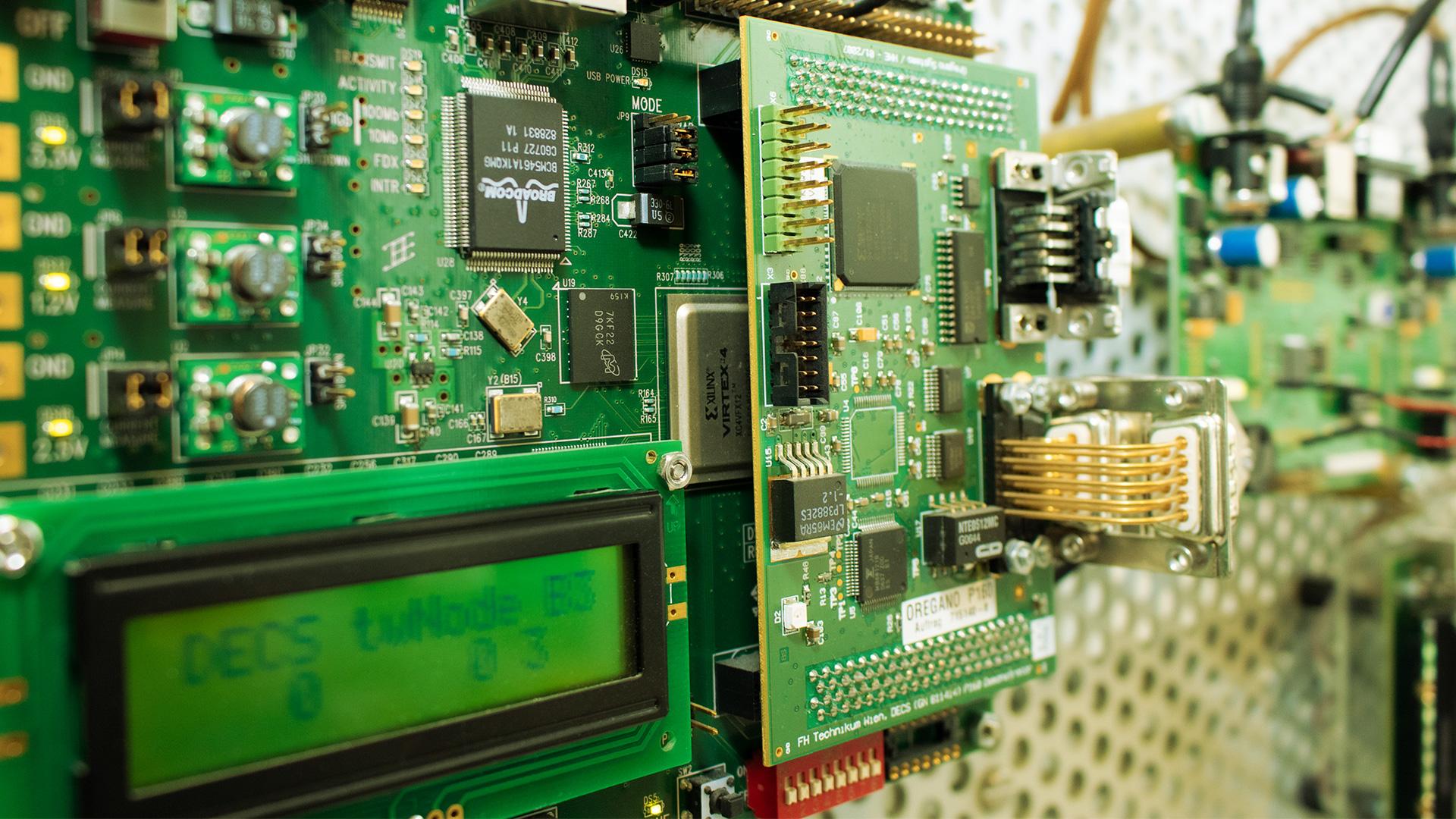
Unlike conventional computers, embedded systems are computers with specific functionality that are integrated, i.e. “embedded”, in the system to be controlled or monitored. They consist of a combination of hardware and software and often contain elements that perform sensor and actuator tasks. In various industrial sectors such as factory automation, medical technology or robotics, embedded systems are indispensable components of innovative products.
The degree program focuses on the development of reliable, fault-tolerant embedded systems and highlights how to deal with the manifold requirements and rising complexity when developing and verifying respective solutions. Covered design topics address things like modern multi-core microcontrollers, system-on-chip devices, embedded AI or modern programming languages like Rust for Embedded. These are used to tackle both functional as well as non-functional aspects like safety and security. Next to concepts targeting architectural system issues the degree program additionally emphasizes on practical hands-on skills that are trained alongside an individual project accompanying the master thesis.
Facts
- Start of Semester: Beginning of September
- Duration: 120 ECTS credits, 4 semesters
- Degree: Master of Science (MSc)
- Mode: Part-time, german (english course material)
- Costs per semester:
- € 363,36 tuition fee (for students from EU/EEA countries) + € 25,20 ÖH fee
- € 3.000,00 tuition fee (for students from non-EU/EEA countries) + € 25,20 ÖH fee
Applicable exemptions from the increased tuition fee: Tuition
- Remote learning elements
- Possibility for a semester abroad
- Recommended semester abroad (optional): 3, 4
- Available Double Degree program(s): Hochschule Luzern
Attendance times
Optional Double Degree Program
The program is also offered as a double degree program in cooperation with the Electrical Engineering or Computer Science master’s degree program UAS Luzern in Switzerland. Students of the Embedded Systems master’s degree program who are accepted into the double degree program study at UAS Technikum Wien the first year and at UAS Luzern the second year. After successfully completing the program, they receive two academic degrees.
Students Learn:
- To develop reliable, fault-tolerant hardware and software for safety-critical applications under real-time conditions.
- To select, integrate and optimize hardware and software components under special, application-specific framework conditions, such as low energy consumption or small form factor.
- Embedded systems, i.e. application-specific hardware/software solutions to be integrated into the environment to be influenced or controlled.
- To develop embedded systems hardware, especially for chip and system-on-chip technologies.
- To design, program, and test embedded systems software for various platforms.
- To select system architectures for embedded systems and distributed embedded systems and adapt them to the specifics of the application.
- To design embedded systems in terms of reliability.
- To design embedded systems for real-time applications.
- To design embedded systems for control engineering applications and integrate them into the environment.
- Based on functional and non-functional requirements, to specify, implement, integrate and test overall solutions, taking into account current standards, rules and societal aspects.
Career Prospects



Requirements
Master’s degree programs build on a completed bachelor’s degree program and allow students to specialize or focus on topics in more detail or to expand their existing expertise.
You must meet subject-matter requirements to be admitted to the Embedded Systems master’s degree program. Prerequisites include a bachelor’s degree from a UAS in a relevant subject matter or an equivalent degree from a recognized post-secondary educational institution (at least 180 ECTS credits) in Austria or another country.
If basic equivalence has been established except for a few missing prerequisites, the program director can require students to take exams to establish full equivalence. These exams are taken during the master’s program.
News from this Program
Contact

Program Director Bachelor Electronic Engineering
Program Director Master Embedded Systems

Administrative Assistant
Download
Application
The next step to study Master Embedded Systems is to apply via our online application system:
- The entire application process is handled via a dedicated application website.
- Your data is stored securely and is being treated with strict confidentiality.
- A registration system makes it possible to start an application and complete it at a later point in time.
- Once you have entered your user data and uploaded documents, you can also use them for subsequent applications.