Research Contribution on Sustainable Buildings: UAS Technikum Wien at EU-PVSEC 2025 in Bilbao
09 December, 2025
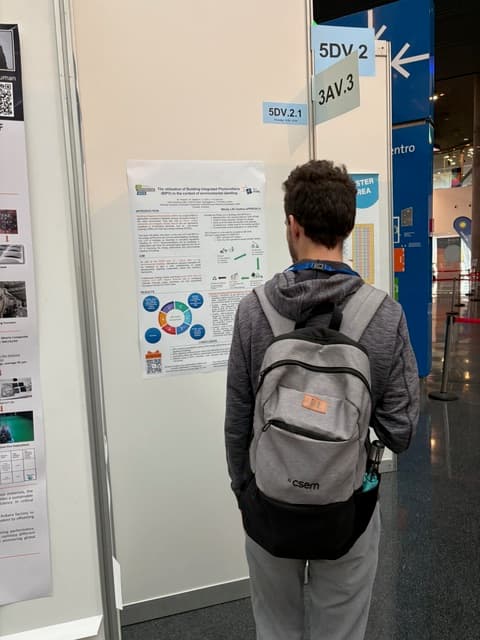
A research team from UAS Technikum Wien was part of the international PV community in Bilbao. A poster presentation highlighted the potential of building-integrated photovoltaics (BIPV) for sustainable construction methods.
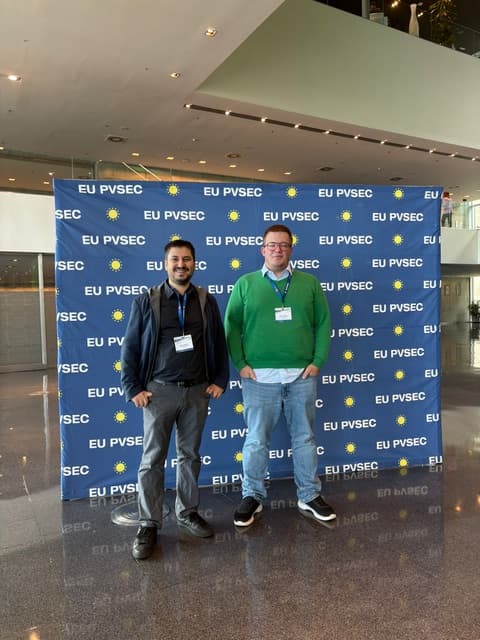
Two representatives from the University of Applied Sciences Technikum Wien, Manuel Trampert (Climate-fit Buildings and Districts competence field) and Momir Tabakovic (Renewable Energy Technologies competence field), attended the European Photovoltaic Solar Energy Conference and Exhibition (EU-PVSEC) in Bilbao, Spain, in September 2025. The EU-PVSEC is one of the world’s most important scientific conferences for photovoltaic research and technology. The researchers presented the latest results from their work on innovative photovoltaic applications in the building sector in a poster presentation.
Research on building-integrated photovoltaics (BIPV)
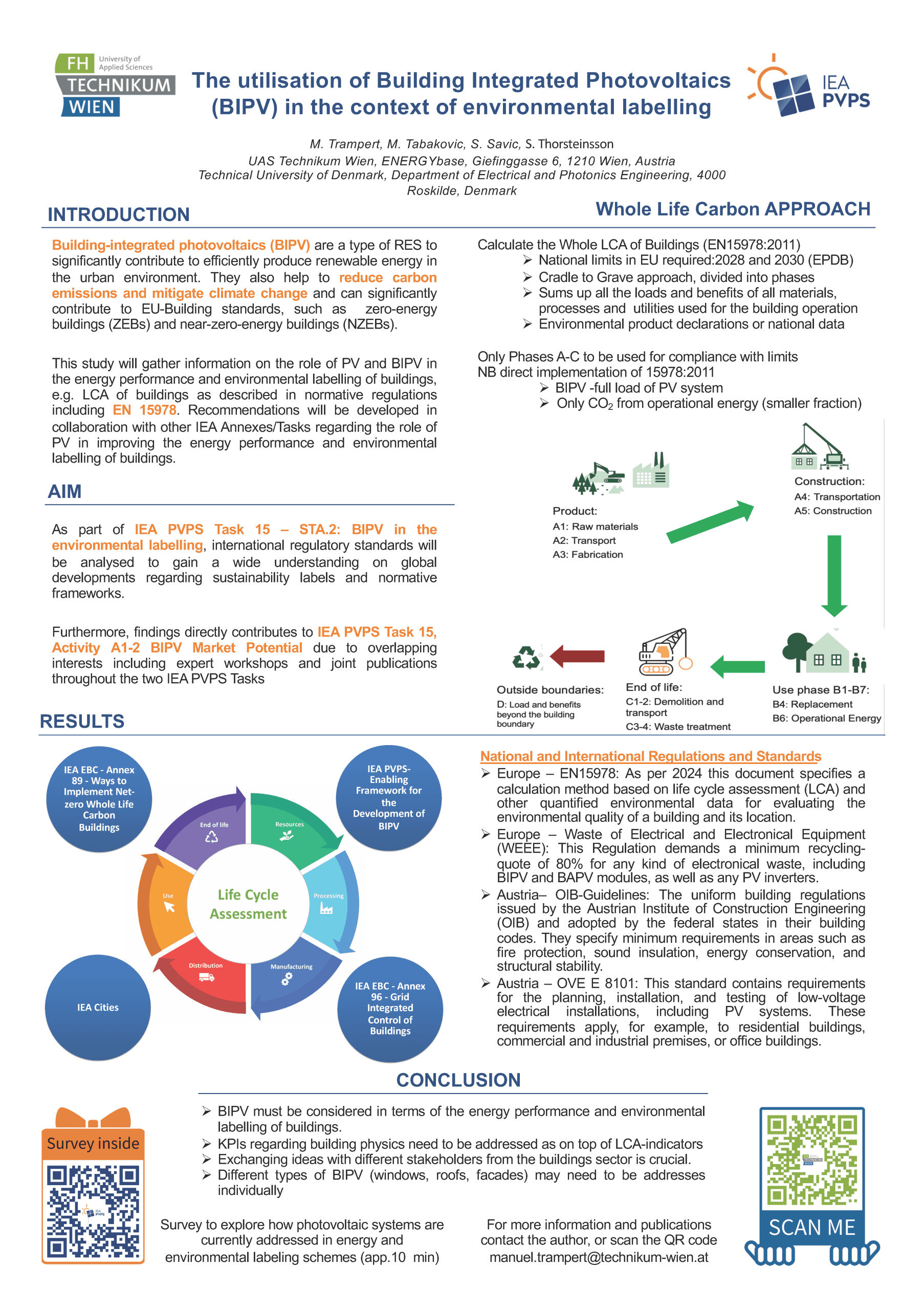
The poster, entitled “The utilization of building-integrated photovoltaics (BIPV) in the context of environmental labeling,” was created in cooperation with Stefan Savic (FH Technikum Wien, Renewable Energy Technologies competence field) and Sune Thorsteinsson (Technical University of Denmark, Department of Electrical and Photonics Engineering).
The research focuses on the question of how Building-Integrated Photovoltaics (BIPV) can contribute to sustainable construction methods. BIPV systems combine architectural elements—such as facades, roofs, or sun protection elements—with photovoltaic power generation. As a result, they perform both structural and energy-related functions.
Contribution to climate-friendly buildings
The study shows that BIPV can be a key technology for nearly zero-energy buildings (NZEB) and zero-carbon buildings (ZEB). Particular emphasis was placed on:
- Reduction of CO₂ emissions through locally produced renewable energy,
- Increased energy efficiency through seamless integration into building envelopes,
- Improved sustainability ratings, for example through more precise life cycle assessment methods,
- Greater integration of BIPV into eco-labels and energy performance standards to more comprehensively reflect its potential in the building sector.
The research team is thus making an important contribution to the further development of international guidelines and labels that are intended to pave the way for climate-neutral buildings.
Here is the poster for download:
Download: UAS Technikum Wien: IEA Task15 Poster – EU PVSEC 2025
Further information:
UAS Technikum at conference for photovoltaic research in Lisbon
Innovative solar projects at European photovoltaic conference
Research results, in collaboration with IEA PVPS Task 15
EU PVSEC – Largest international conference for photovoltaic research
Picture Gallery: