MAIJA Combines Innovative Technologies for the Correctional System with a Digital Assistant
06 July, 2026
A unified platform integrates inmate and task management, alert systems, and LLM-powered reports. Testing provided feedback for future implementation in Austrian correctional facilities.
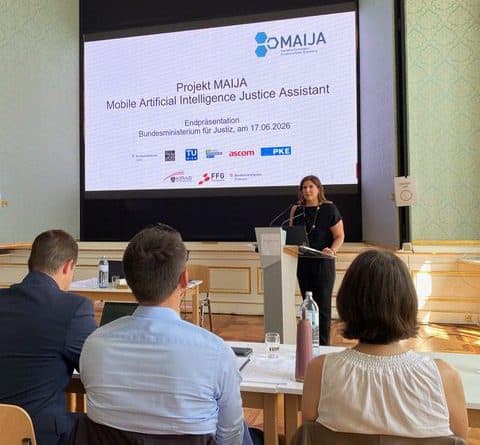
At the end of June 2026, the KIRAS research and development project “MAIJA” was successfully completed. The goal of the project was to investigate how innovative technologies could be integrated into a digital assistant for the correctional system in order to digitize processes—such as cell searches and shift handoffs—that had previously been documented primarily in analog form.
During the project, the consortium partners worked closely together to develop a prototype of an AI-powered digital assistant for use in Austrian correctional facilities and to gain valuable insights into increasing the level of digitization in the correctional system.
Application Platform for Inmate and Task Management as well as Alerts
Ascom’s central application platform is used for inmate and task management as well as location-based alerts. The components of the digital assistant developed by UAS Technikum Wien and TU Wien include facial recognition based on a custom-built database, incident logging with voice-to-text functionality, shift handoffs with an overview of relevant events from the previous shift, open tasks, customizable routine checks, and a list of absent individuals, as well as AR-supported cell searches. These components are interconnected via a MAIJA backend developed by PKE, which also provides AI-generated recommendations for action.
Components of the MAIJA applications tested with correctional officers
In addition, the digital assistant supports report generation through the use of Large Language Models (LLMs). Finally, as part of a full-day evaluation led by VICESSE, all components of the MAIJA applications were tested with correctional officers to gather important feedback for potential further development.
Development work in the field of AI-supported assistance solutions for the public sector
The results achieved form an important foundation for the further development and future deployment of digital assistance systems in the judicial system, as well as for ongoing research and development work in the field of AI-supported assistance solutions for the public sector.
The project team would like to thank all consortium partners—the Federal Ministry of Justice, the Computer Vision Lab at the Vienna University of Technology, VICESSE, PKE, and Ascom—for their excellent collaboration, as well as the Austrian Research Promotion Agency (FFG) and the Federal Ministry of Finance for their support of the project.
Further Information:
MAIJA: Innovative Technologies for a Secure Correctional System (May 2024)
Picture Gallery: