3D Printing, VR, and Ergonomics: A Hands-On Week for Master’s Students in Bergamo
24 June, 2026
Students in the Health and Rehabilitation Technology program report on the Erasmus+-funded Blended Intensive Program in Italy.
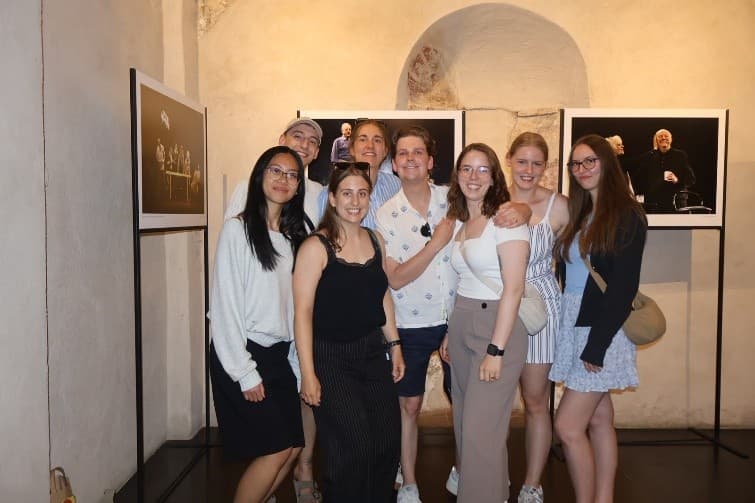
Eight students in their second semester of the Master’s program in Health and Rehabilitation Technology report on the Erasmus+-funded Blended Intensive Program (BIP) in Bergamo. The program focused on “Human Safety” and “Engineering Solutions for Human-Centered Applications.”
Online Phase and Preparation
The Blended Intensive Program began on February 27 with an online kick-off event. After an overview of the participating universities, the program, and the project topics, we were assigned to international project groups. In the weeks that followed, we held our first online meetings with our advisors, during which we discussed our project ideas and planned our next steps. The Virtual Study Week took place from April 13 to April 17. The content of the online lectures served as the foundation for our further project work and was subsequently assessed through short mini-quizzes. At the same time, we had a “Mission Impossible” to tackle: During this online phase, the groups completed creative tasks, such as adapting an Italian recipe or planning a group vacation, to get to know each other better beforehand. After the Virtual Study Week, we continued to develop our project concepts in regular online meetings.
The On-Site Week in Bergamo
The in-person phase took place from June 8 to June 12 in Bergamo. After the welcome, a campus tour, and a brief introduction to the week’s program, we got to know the other students and instructors in person. We spent most of the week working on our projects. Compared to the online phase, collaboration on-site was significantly easier and more efficient, as decisions could be made immediately. During the on-site week, we also visited various labs and workshops. In the 3D Modeling and Additive Manufacturing lab, we were shown a special 3D printer for biological tissue, and we modeled a brain tumor using the 3D Slicer software. In the workshop on Virtual Reality and Motion Capture, we were able to test VR applications and, in the Ergonomics lab, learn about practical systems for motion analysis. During our visit to the Kilometro Rosso Innovation Park, we took a guided tour and attended presentations on “organs on a chip” as well as various robotics projects.
Cultural Program and Conclusion
During the on-site week in Bergamo, the “Mission Impossible” continued with new challenges. These included designing a garment with built-in fall protection, searching for the cheapest Margherita pizza, and finding a location with a high risk of falling—all of which provided a varied complement to our project work. At the end of the week, we took a group tour through the Città Alta to explore the old town. This was followed by the closing dinner at the Circolino Restaurant, where we were able to wrap up the week in a relaxed atmosphere. On the last day, all groups presented their project results. Overall, the Erasmus+ BIP was a very interesting experience, as it focused on both professional and personal development. The combination of the online phase and the in-person week worked well and allowed us to prepare flexibly and collaborate intensively on site.