Cybersecurity, Deep Tech, and Protection Systems at a Startup Event
29 September, 2026
At “Start me up Monday,” researchers, startups, and companies demonstrated how technological innovations address societal and infrastructural challenges.
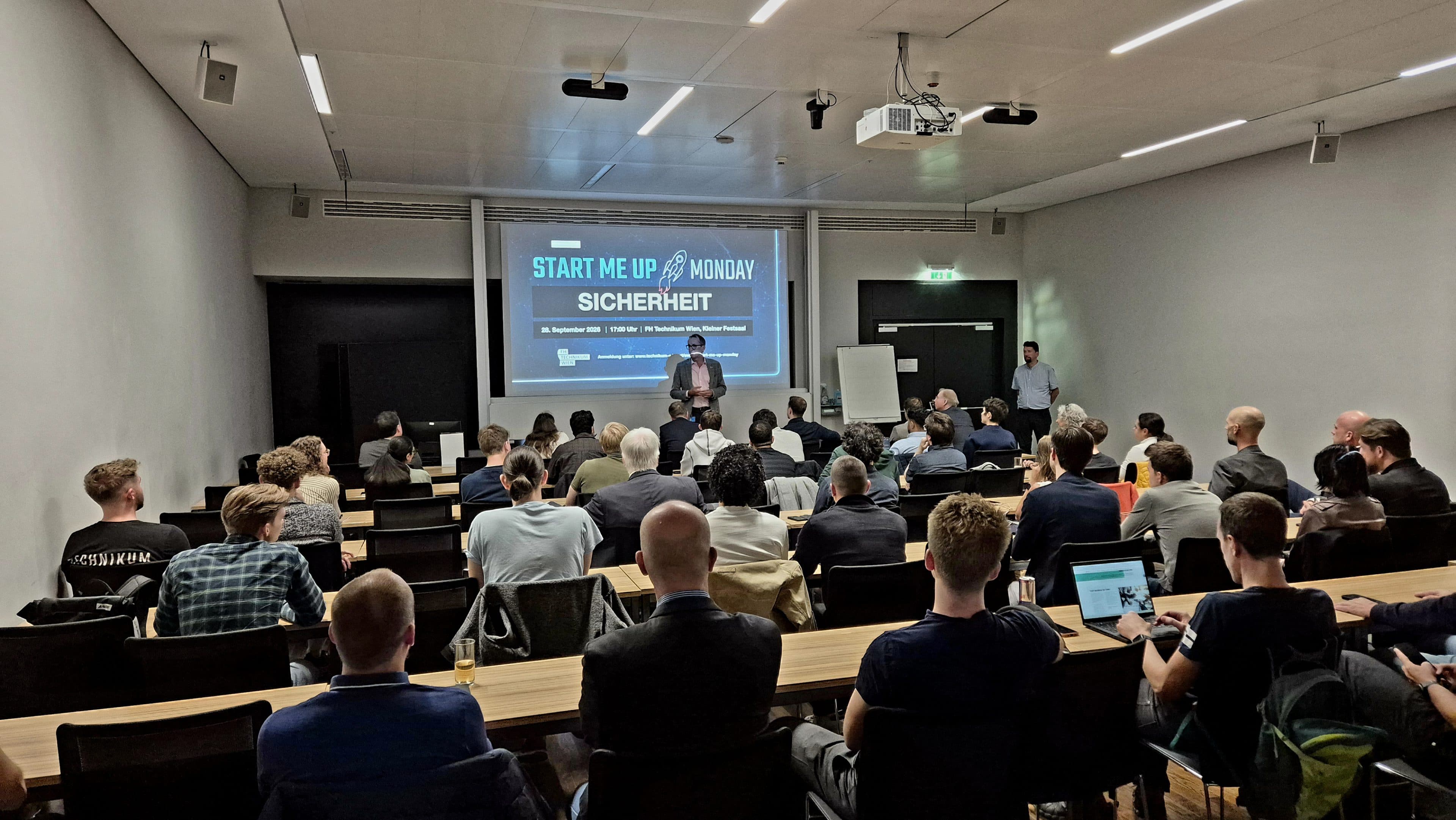
This time, the “Start me up Monday” event at UAS Technikum Wien focused on cybersecurity, deep technologies, and modern protection systems. Researchers, established companies, startups, and funding agencies provided insights into current risks, practical solutions, and the next steps toward building resilient infrastructures—with plenty of opportunities for discussion and networking.
The evening began with opening remarks by Horst Rode (Managing Director of UAS Technikum Wien) and Rafael Rasinger Amilivia (Head of Innovation, Scaleups & Networks).
Research and Funding
Adrian Dabrowski, director of the IT Security master’s program at UAS Technikum Wien, placed current threats in a broader historical context: After decades of attacks such as SQL injections, the focus today has shifted to prompt injection—a blurring of the line between context and intent that demonstrates how attack surfaces are changing with AI. The next layer involves the division of roles among the client, tool, instrument, and agent. The term “alignment failure” highlights how important it is to synchronize AI systems with the client’s goals and expectations. Dabrowski used the image of “The Sorcerer’s Apprentice”: Unlike in the ballad, no master will appear at the end to put an end to the chaos—security must be integrated into the system design from the very beginning.
Karl Schiller (Austria Wirtschaftsservice) provided a concise overview of the wide range of funding opportunities available to deep-tech startups. His conclusion: Ambitious development projects in the fields of security and infrastructure require the right tools.
Security Technology for Critical Infrastructure
Martin Marienschek (Head of Corporate Communications and Human Resources Development) introduced PKE, an industry leader that supplies security technology for highly critical sectors—including emergency response organizations such as Cobra, the Office for the Protection of the Constitution, and the National Bank. PKE combines reliable, proven products with innovative projects, such as video surveillance in the Wiener Linien subway system. The approach: robust systems that are continuously evolving.
Cyber Risk Assessments in a Military Context
Sascha Kristament (Vehicle Cyber Security Manager at Rheinmetall) demonstrated how the military vehicles manufactured by Rheinmetall in Vienna are protected against cyberattacks throughout their entire product lifecycle. Even though these systems are not designed as cloud-based or connected consumer devices, there are numerous potential points of vulnerability—from development and production through to operation. Security is therefore integrated as a cross-functional task into every stage of development.
Safety from the Air
Michael Schiller (Schiebel Elektronische Geräte) presented the company’s helicopter drone platform, which is used in both civilian and military scenarios. The focus was on interoperability with new sensor technology and software—including solutions from startups. In this way, drones are becoming open integration platforms for the next generation of security applications.
Startups in the security sector
FOREUS (Stefan Embacher, CEO) operates at the intersection of software and operational consulting: Intelligence-as-a-Service and SaaS solutions support banks, corporations, and government agencies in areas such as supply chain security and dual-use export controls. Compliance departments use the software directly; in consulting projects, FOREUS collaborates with law firms.
Muse Electronics, with its Backbone product (Gerald Zach, CTO), addresses data autonomy and secure communication. The company developed a 10-inch tablet from the ground up to meet military requirements. The concept is “stateless” and multi-domain-capable: the device and storage remain empty of data, and a removable boot medium defines the operational domain and hardware access. This creates clear separations and controllable security zones.
Community and Network
Christopher Chellakudam gave a brief introduction to Start Vienna and invited students to network within the startup community. In addition, several members of the startup mentor network presented themselves at the Technikum: Maria Marienschek, Benedikt Salzbrunn, Evgeniia Filippova-Karlusch, Thomas Wala, and Wolfgang Fidi.
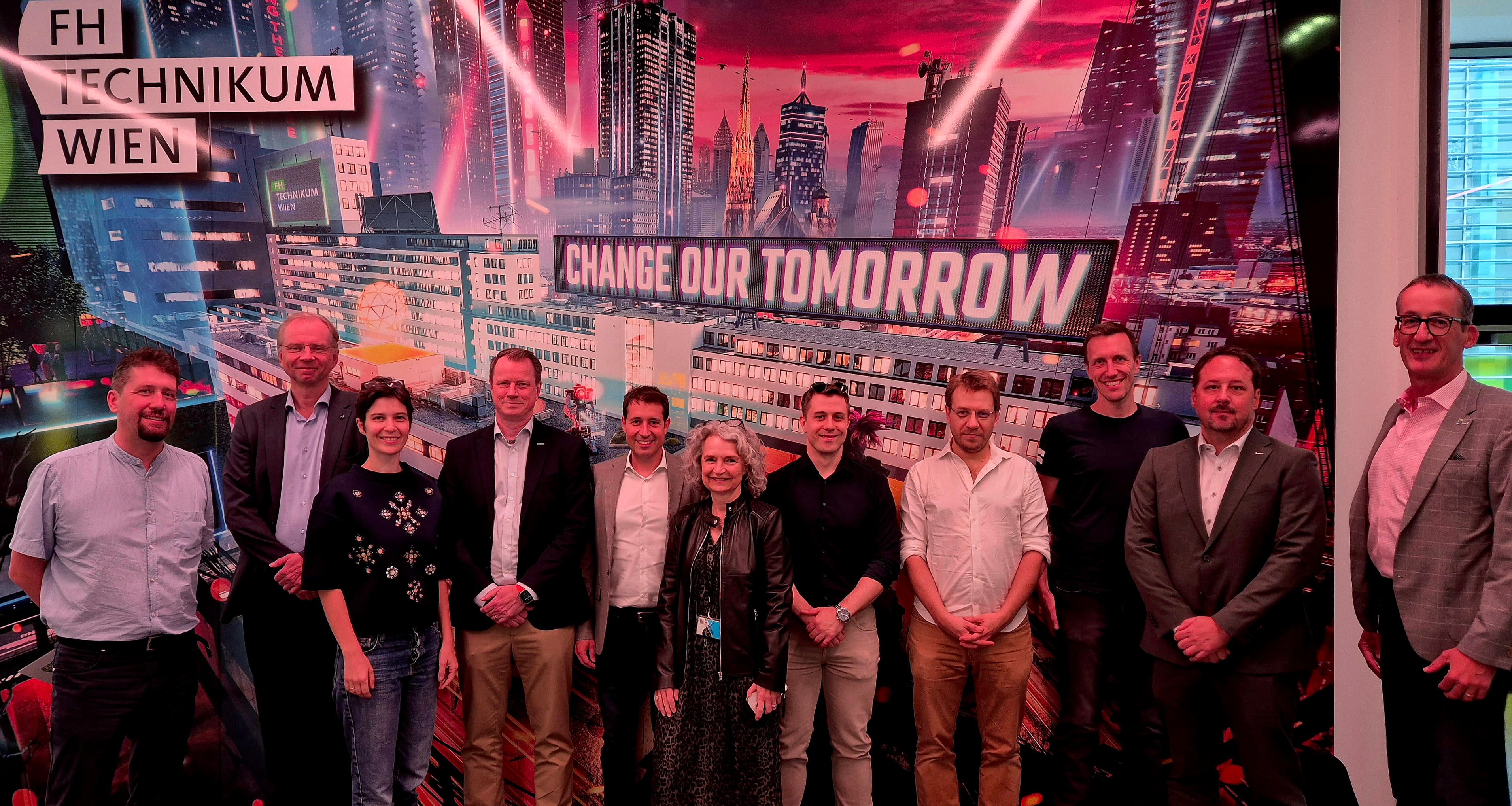
from left to right.: Rafael Rasinger, Karl Schiller, Evgeniia Filippova-Karlusch, Martin Marienschek, Gerald Zach, Maria Marienschek, Sascha Kristament, Adrian Dabrowski, Benedikt Salzbrunn, Michael Schiller, Horst Rode