
IEA Networking Meeting 2026: Focus on Building-Integrated Photovoltaics
02 March, 2026
Experts from research and practice exchanged views on the role of integrated photovoltaics in climate-neutral construction. Momir Tabakovic presented work on Building Integrated Photovoltaics (BIPV) as part of IEA PVPS Task 15.
On January 19, 2026, the annual networking meeting of national stakeholders in the IEA research cooperation took place at the Urania in Vienna. The focus was on the role of renewable energies as drivers of system transformation and as a factor for competitiveness. The University of Applied Sciences Technikum Wien was represented with a contribution in the thematic block on projects of the IEA research cooperation.
Contribution by the University of Applied Sciences Technikum Wien to IEA PVPS Task 15
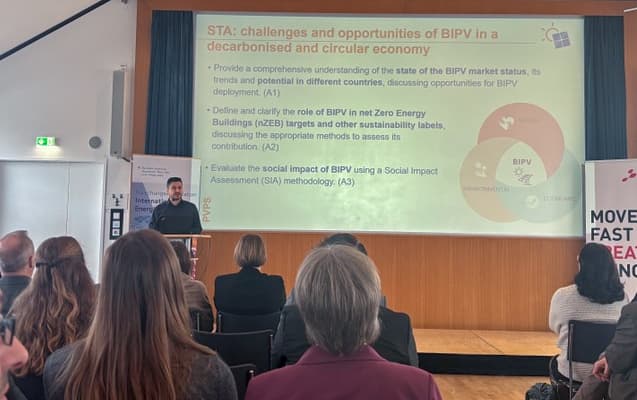
Momir Tabakovic (Head of Renewable Energy Technologies at the University of Applied Sciences Technikum Wien) spoke together with Gabriele Eder (Austrian Research Institute for Chemistry and Technology, OFI) about “Building Integrated Photovoltaics” (BIPV) – i.e., photovoltaics used as a component of building envelopes and building materials. IEA PVPS Task 15 aims to create an international framework that strengthens BIPV as a fully-fledged alternative to conventional building materials, taking into account aesthetics, safety, performance, and costs. The social impact and long-term benefits of BIPV are also being systematically evaluated.
Why BIPV is gaining importance now
Tabakovic pointed out that BIPV can be a key element in the decarbonization of the building sector, but that technological, regulatory, and life cycle assessment hurdles are still slowing down its widespread implementation. The pressure to act is high: in Europe alone, around 35 million buildings will need to be renovated over the next ten years, with the necessary investments estimated at around € 900 billion. Against this backdrop, there are great opportunities for BIPV – especially in the context of the move towards net-zero buildings and extensive renovation programs.
Further Information:
PDF report on the IEA networking meeting 2026
IEA networking meeting: Renewable energies as drivers of system transformation and competitiveness (January 19, 2026)
IEA research cooperation within the framework of open4innovation
Photovoltaics: FHTW at the kick-off meeting for IEA PVPS Task 15 Phase 3
Research project IEA PVPS Task 15.2 (UAS Technikum Wien)
Faculty of Industrial Engineering (UAS Technikum Wien)