Student Presented Project Work on Voltage Stabilization in Low-Voltage Grids at Smart Grids Fall Meeting
10 October, 2025
Ziel der Arbeit von Florian Liszt, Student des Master-Studiengangs Renewable Energy Engineering, ist es, dabei zu helfen durch maschinelles Lernen die Netzstabilität trotz dezentraler Einspeisung zu sichern.
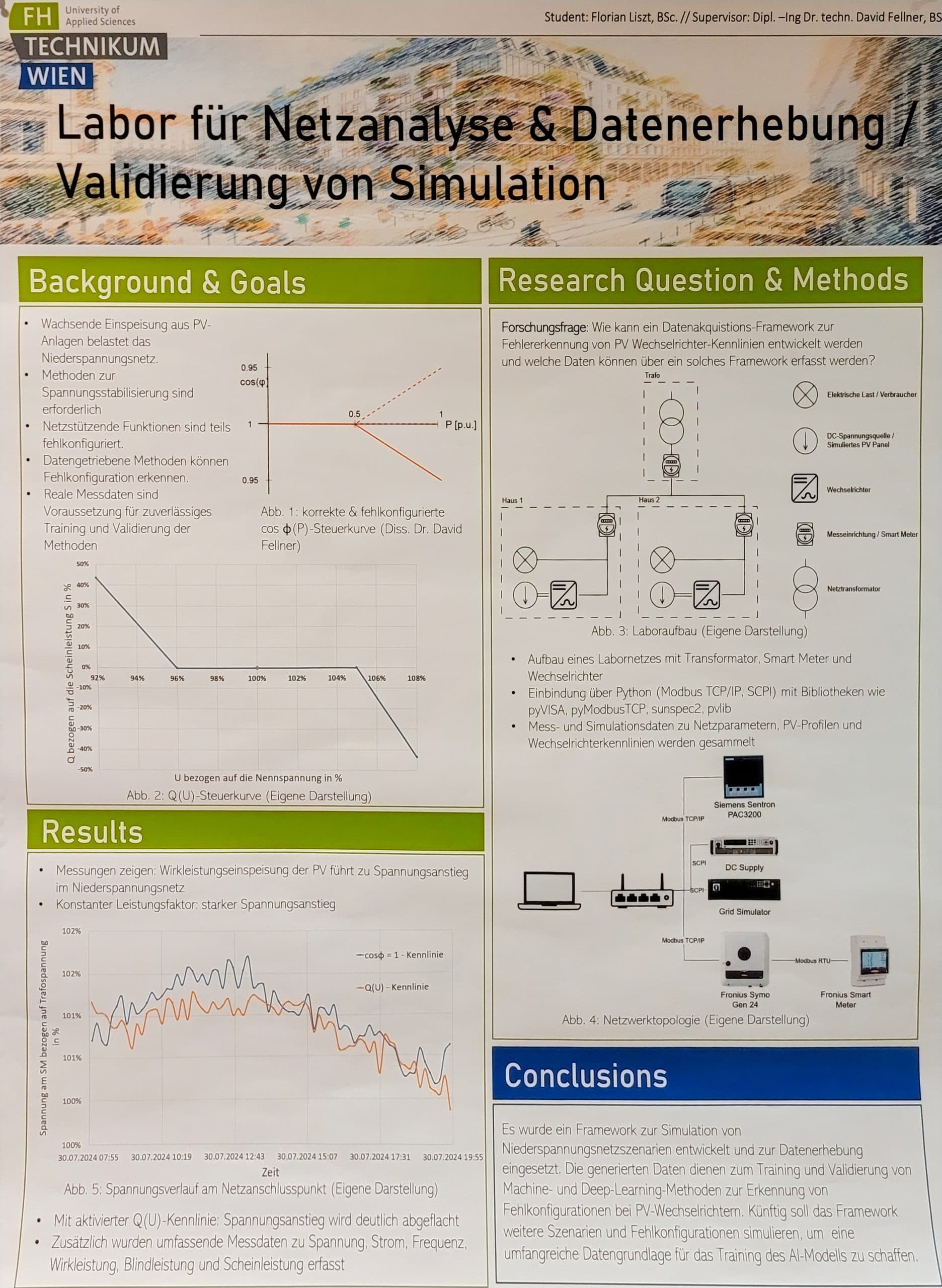
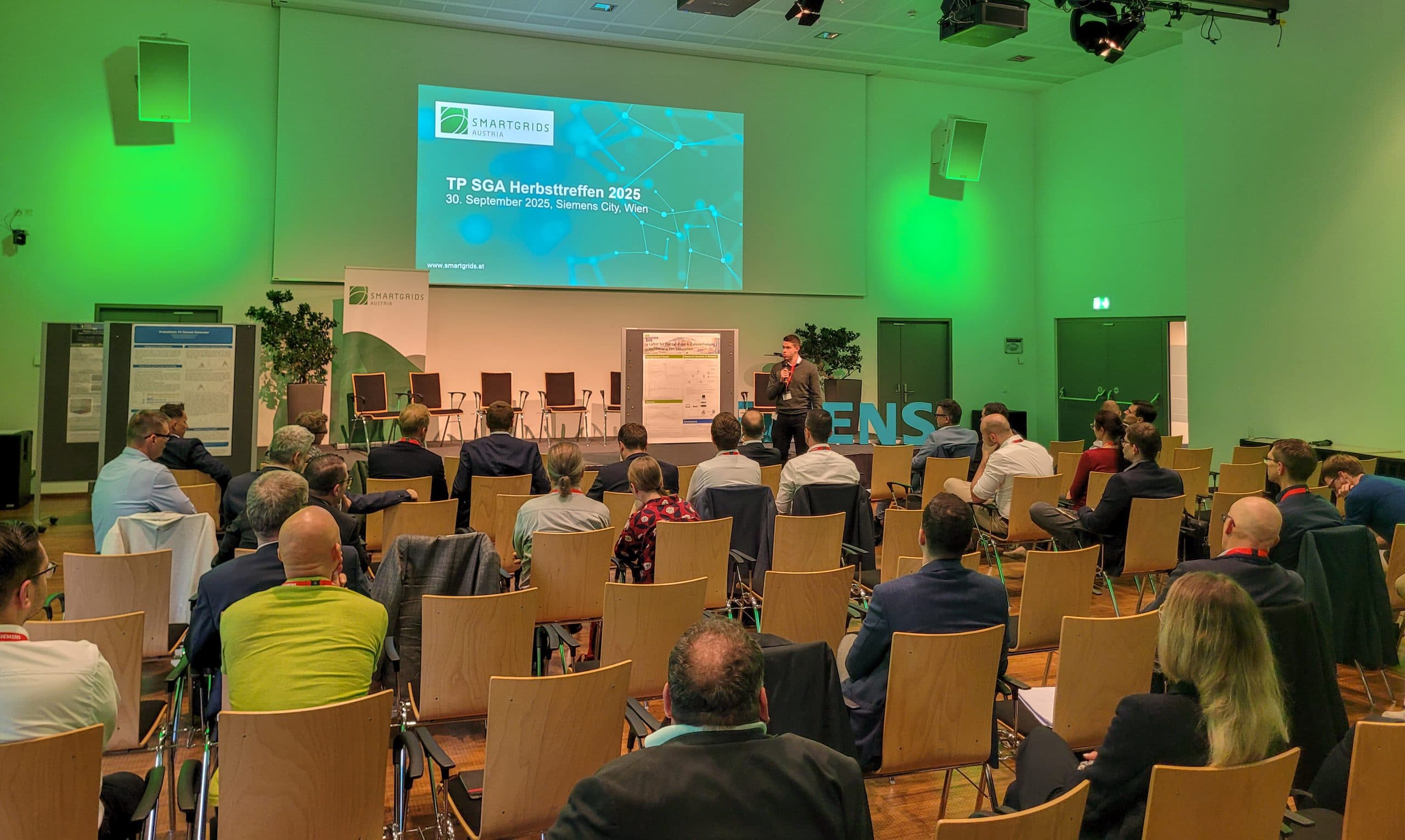
At the Smart Grid Autumn Meeting 2025, Florian Liszt, a student in the Master’s program in Renewable Energy Engineering, presented a poster on his research work on voltage stabilization in low-voltage grids. He was accompanied by David Fellner, program director for the Bachelor’s and Master’s programs in Renewable Energy Engineering.
The work presented was developed as part of a project course under the supervision of David Fellner and was carried out together with students Michael Waldher, Hans Baumgartner, and Andreas Dietmeier. The topic is also part of the GridEdge research project, an example of research-driven teaching at the University of Applied Sciences Technikum Wien.
AI-supported voltage stabilization in the low-voltage grid
The aim of the work is to support the development of new data-driven methods to detect misconfigurations in PV inverters and improve voltage stability in low-voltage grids. The increasing feed-in from photovoltaic systems often leads to voltage increases, while incorrectly configured grid support functions (e.g., Q(U) control) can cause additional problems.
To address these challenges, a framework for simulating low-voltage grid scenarios was developed in the EnergyBase laboratory. This enables the generation of measurement data for the training and validation of machine and deep learning models.
Real measurement data on voltage, current, frequency, and active, reactive, and apparent power are recorded, both with correctly and incorrectly configured Q(U) control. The laboratory framework comprises a transformer, smart meter, and inverter, which were integrated via Python interfaces and libraries such as pyVISA and pyModbusTCP.
In the long term, the system will be expanded to simulate additional fault scenarios and create a comprehensive database for AI-supported grid analyses.
Research meets teaching
The presentation impressively shows how students at the University of Applied Sciences Technikum Wien actively participate in practical research and learn from it. The close link between teaching and ongoing research projects – as in the case of GridEdge – creates a valuable transfer of knowledge between academic education and technological innovation.
Further information:
Bachelor’s program in Renewable Energies
Poster on Florian Liszt’s research work: “Voltage stabilization in low-voltage grids”: