The Art of Energy: Experiencing Sustainability in Spittelau
14 April, 2026
Students from the Bachelor’s degree program in Sustainable Environmental and Bioprocess Engineering report on their field trip to the “most beautiful waste-to-energy plant in the world.”
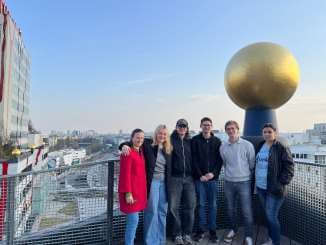
The following report was written by students in the Bachelor’s degree program in Sustainable Environmental and Bioprocess Engineering. They visited the waste-to-energy plant together with Master’s students from Environmental Management & Ecotoxicology.
How does a modern waste-to-energy plant actually work? What can it process? Food scraps, a toy car, a mattress, or even a small car? Students in the Bachelor’s degree program in Sustainable Environmental and Bioprocess Engineering explored these and many other questions.
Behind the Hundertwasser facade
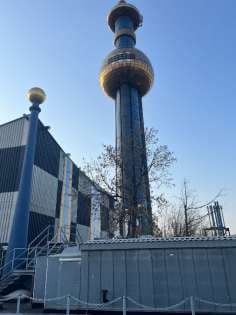
The plant was originally built between 1966 and 1971 as a purely functional structure. A devastating fire on the night of May 14–15, 1987, destroyed large parts of the facility and necessitated a comprehensive renovation. As part of the reconstruction, the renowned artist Friedensreich Hundertwasser was commissioned to redesign the facade, but under a single strict condition: the most modern filter technology available had to be installed.
A waste-to-energy plant in the middle of the city—why?
Spittelau is deliberately located in the heart of Vienna: short transport routes reduce emissions and costs, while the facility simultaneously feeds electricity and district heating directly into Vienna’s grid. This way, around 1,000 tons of residual waste are converted daily into energy—in the form of electricity and district heating—for up to 76,000 Viennese households. The most recent increase in capacity is primarily due to the newly installed large-scale heat pump. Thanks to state-of-the-art filtration technology, emissions are reduced to a minimum; nevertheless, the plant emits approximately 126,000 tons of carbon dioxide annually, which shows us that even the most efficient waste-to-energy plants are not completely emission-free.
Learning from a real-world example
The field trip with students from the Bachelor’s degree program in Sustainable Environmental and Bioprocess Engineering highlighted how closely environmental technology, waste management, and the circular economy are intertwined. For the students, it provided practical insight into processes they learn about theoretically in their studies—and at the same time served as food for thought regarding a more conscious use of resources. This is very much in the spirit of Friedensreich Hundertwasser, who summed it up perfectly: Sustainability begins with not producing any waste in the first place, rather than burning it efficiently later on. No matter how advanced facilities like the one in Spittelau may be, waste prevention always remains the most important solution.
Finally, an unusual incident brought a smile to everyone’s face: A VW Beetle once ended up in the Spittelau waste bunker. Because it was too large for incineration, it first had to be cut into smaller pieces on site.